A Quick Guide for the Front Desk: How to Save the Job
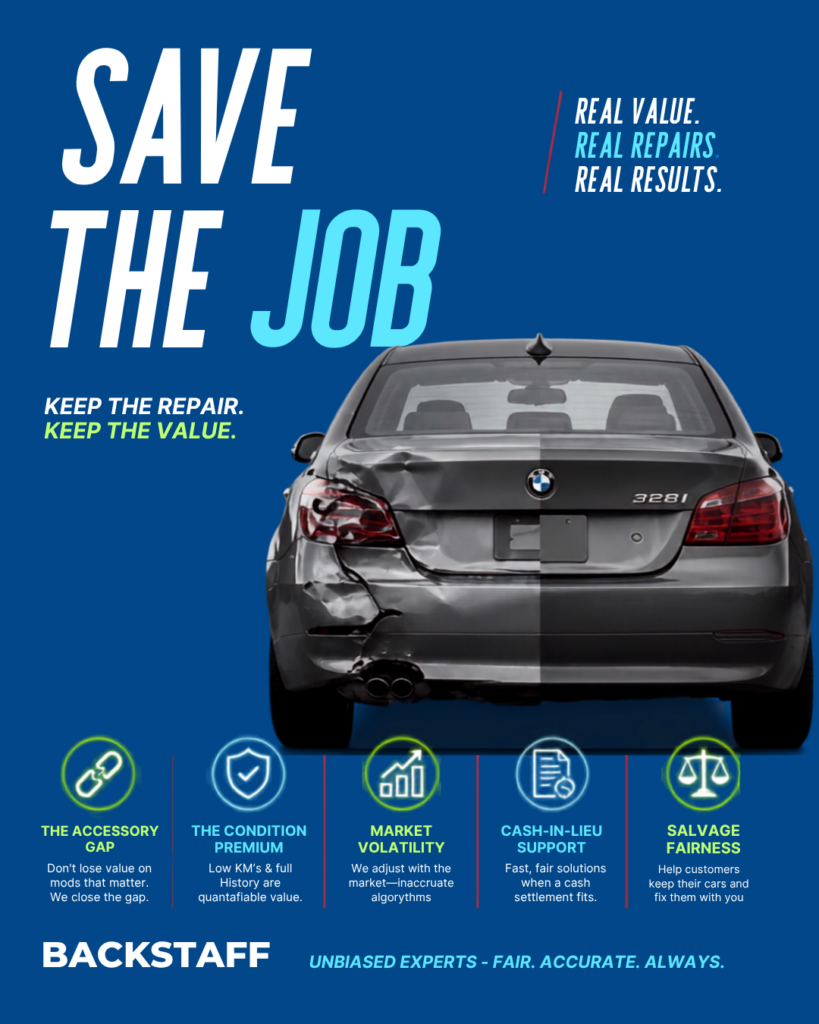
 WAIT! Before You Let the Tow Truck Take That “Total Loss”…
It’s frustrating: You’ve written a great estimate, you have the bay space, but the insurer flags the car as a total loss.
Before you hand over the keys and lose the revenue, you need to find out why it was written off. If it’s a numbers game based on a low Pre-Accident Value (PAV), you can save the job by educating the customer on their right to an independent valuation.
Here is exactly WHEN it works, WHEN it doesn’t, and HOW to explain it to the customer.
 FIRST: Know When a Job CANNOT Be Saved (Statutory Write-Offs)
Before offering the customer any hope, you need to know if the insurer’s assessor has declared the car a Statutory Write-Off (Stat Write-Off).
What it is: The car has suffered severe structural, fire, or flood damage.
The Rule: A Stat Write-Off means the car is legally deemed unsafe to ever go back on the road. Its VIN will be cancelled, and it can only be used for scrap or parts.
The Bottom Line: A higher valuation from Backstaff cannot save a Stat Write-Off. This is a safety/legal decision, not a financial one. Let this job go.
 WHEN to Step In: Spotting the “Saveable” Job (Economic Write-Offs)
If the car is an Economic Write-Off (meaning the insurer just thinks it costs too much to fix compared to what they think it’s worth), a higher valuation can save the job. Look and listen for these 4 scenarios:
The “Loaded” Rig (Hidden Extras): The car has thousands of dollars in non-standard upgrades (bull bars, custom canopies, lifted suspension). Insurance AI systems usually value it as a “base model” and miss these completely.
The “Unicorn” (Low KMs & Mint Condition): It’s an older model but has incredibly low mileage and a flawless logbook. The insurer is valuing it against a high-mileage average.
The Sentimental Owner (Cash-in-Lieu): The customer really doesn’t want to lose the car and wants a cash payout to pay you to fix it, but the insurer’s cash offer is too low to cover your estimate.
The Salvage Buy-Back: The customer wants to buy the “wreck” back from the insurer and pay you to fix it, but the insurer is charging them too much for the salvage value.
 HOW to Step In: The Front Desk Script
If you confirm it is an Economic Write-Off and fits one of the scenarios above, it’s your job to let the defeated customer know they can fight back.
Here is what you tell them:
1. Empathize & Validate: “I know the insurer is telling you this is a total loss, but because this is a financial write-off—not a safety write-off—you actually have options. Looking at your car, their valuation seems way too low. They are likely using automated software that misses the true value of your vehicle.”
2. Introduce the Solution: “You have the right to dispute their number. We work with an independent valuation company called Backstaff. Unlike the insurer’s computers, they use real human assessors to look at your specific upgrades, your low kilometers, and the current market.”
3. Explain the Benefit: “If Backstaff can prove your car is worth more, it raises the limit of what the insurer is allowed to spend on repairs. This often turns a financial ‘write-off’ back into an approved repair—or gets you a high enough cash payout to let us fix it for you. Would you like me to connect you with them?”
 The Win-Win
By taking 2 minutes at the front desk to educate the customer, you advocate for them when they are most stressed.
The Customer Wins: They get a fair payout and get to keep the car they love.
The Shop Wins: You rescue a lost job, keep the car in your bay, and build massive customer loyalty.
Don’t let bad insurance software steal your jobs. If it’s an economic write-off, offer the customer a Backstaff valuation.